
Men search for the answer to the question ‘can phimosis be cured without circumcision’ since they want a reliable answer before deciding on a permanent course of action.
The straightforward clinical opinion is that circumcision is not always necessary in cases of adult phimosis. Circumcision is generally regarded as an option only after less invasive treatments have been attempted, except when there is considerable scarring or an existing skin disorder like BXO for which conservative treatment is not likely to be effective.
The guide deals with what phimosis is, what really decides on the treatment, and when circumcision is (and is not) the appropriate option, whether or not phimosis can be cured without circumcision in your specific case.
What is Phimosis in Adults?
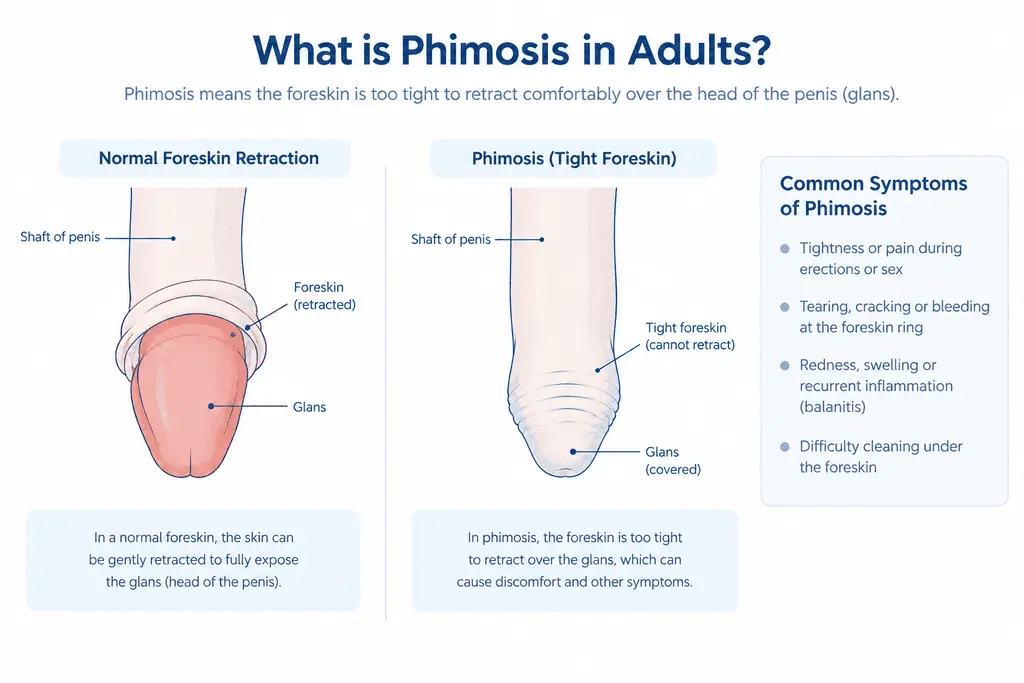
The condition known as phimosis is one in which the foreskin is so tight that it cannot be comfortably retracted over the head of the penis (the glans). Occasionally men refer to it merely as an extremely tight foreskin. In adults it can cause:
- Pain or tightness during erections or sex
- Tearing, cracking, or bleeding at the foreskin ring
- Soreness, redness, swelling, or recurrent inflammation (balanitis)
- Difficulty cleaning under the foreskin
Some tightness comes from temporary inflammation. Other cases are caused by scarring that gradually makes the opening less elastic.
Tight vs Scarred Foreskin: The Key Difference
If you take only one thing from this post, make it this:
Tight (inflammation-related)
The foreskin can become tight due to irritation or infection and the tissue is generally still elastic, improving with medical treatment.
Scarred (pathological phimosis)
A scarred foreskin ring is typically thicker, less stretchy, and more likely to split. Scarring can follow repeated micro-tears, recurrent inflammation, or skin conditions such as lichen sclerosus (BXO). In these cases, non-surgical options are less predictable, and recurrence is more common.
This “tight vs scarred” distinction is what usually determines whether circumcision is necessary.
| Tight (inflammation-related) | Scarred (pathological phimosis) | |
| Appearance of the ring | Normal colour, still stretchy | Thickened, often pale or white |
| Elasticity | Retains elasticity | Inelastic, splits rather than stretches |
| Usual cause | Irritation, infection, balanitis | Repeated micro-tears, BXO / lichen sclerosus |
| Response to steroid cream | Usually good | Unpredictable, recurrence common |
| Is stretching appropriate? | Sometimes, after assessment | No |
| Typical outcome | Often resolves without surgery | Circumcision usually the reliable option |
When Circumcision Is Recommended
Circumcision is more often recommended in cases where it is likely that creams and conservative treatments will not provide long-term relief; this is the situation in which adult circumcision for phimosis is most frequently required.
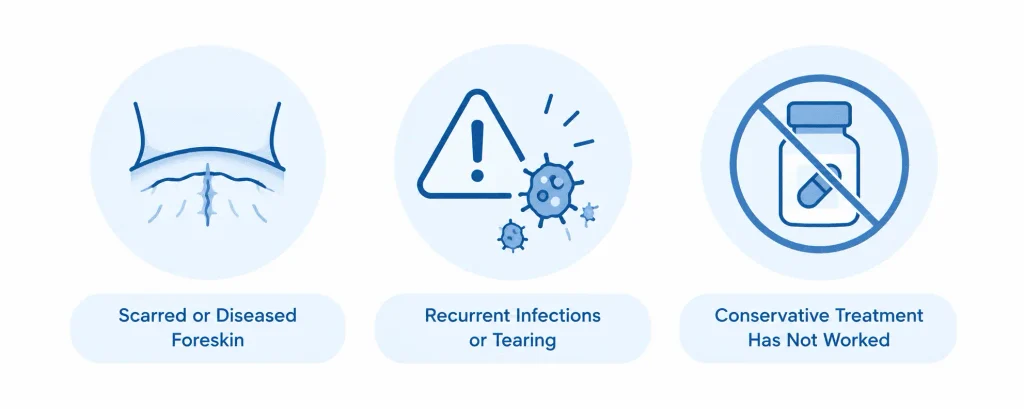
Suspected BXO or lichen sclerosus
Circumcision is usually considered in such cases where the foreskin is scarred or inelastic (a condition which is often indicated by a pale or white ring, cracking, or by progressive tightening) since the relief of symptoms through conservative treatment may be limited.
Recurrent infections or repeated tearing
Surgery might then become the most permanent option if you are continually experiencing inflammation under the foreskin or if the ring splits during erections or sex (and then heals up more tightly).
Conservative treatment has not worked
The NHS lists topical steroid creams and antibiotics alongside surgery as treatments for a tight foreskin, and in current UK practice circumcision is normally considered once these less invasive measures have been tried without lasting benefit.
When Circumcision Is Not Always Needed
Circumcision may be avoidable when:
- Tightness is mild, and the foreskin is not fixed/scarred
- Symptoms are mainly due to treatable inflammation or infection
- The main restriction is the frenulum (a tight band under the glans) rather than the foreskin opening
- You strongly prefer to keep the foreskin, and you are a good candidate for a foreskin-preserving procedure like preputioplasty
What you want is to select the option that is the least invasive while still ensuring that you get a reliable result.
Can Adults Cure Phimosis Without Circumcision?
Yes, that is true, especially in the early or mild instances.
How to Treat Phimosis without Circumcision
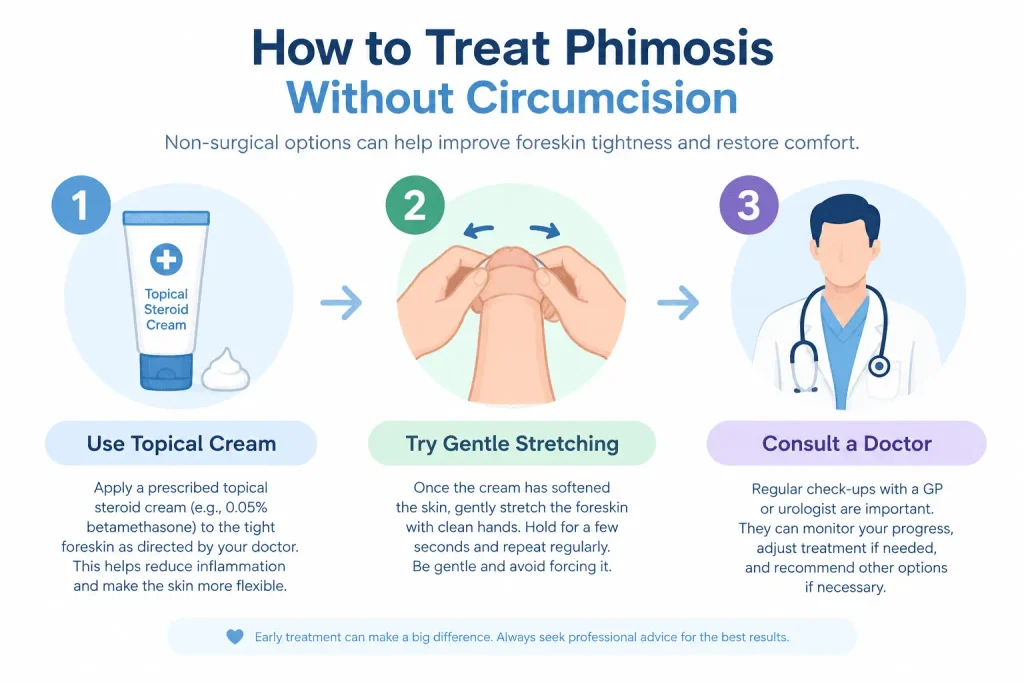
Depending on the cause, treatment may include:
- Topical steroid cream/gel to soften the skin and improve retractability
- Treating infection/inflammation (for example, antibiotics if there is an infection)
- Gentle phimosis stretching only if appropriate after starting steroid treatment, and only to the point of tightness (not pain)
- Foreskin stretching rings — graduated silicone rings worn under the tight ring for short periods each day, usually alongside steroid cream, to apply gentle sustained stretch and widen the opening in small steps
- Balloon dilatation — a small balloon device passed under the foreskin and slowly inflated to widen the preputial ring; some men find the pressure easier to judge than manual stretching
- Both ring stretching and balloon dilatation are only suitable where the foreskin is tight but still elastic; neither should be used on a scarred foreskin or where BXO is suspected
Phimosis Treatment at Home: A Safety Note on Stretching
If you want a tight foreskin home solution, it is essential to know the limits. In the case of diseased foreskin or scarred, stretching may cause micro-tears which in turn result in more scarring and a more severe phimosis in the future. In our practice we do not advise stretching before
the foreskin has been examined.
If you’re not sure if you have scarring (or possible BXO), don’t try to pull it back—you should get an assessment.
Foreskin-Preserving Surgery Options
If you need a procedural solution but want to keep the foreskin, there are options for selected patients:
Preputioplasty
Preputioplasty is an operation which preserves the foreskin by widening the tight ring. It is most appropriate in cases where the tissue is not severely scarred and in instances where it is desired to keep the foreskin; however, it is usually not suitable when tightness is caused by BXO or lichen sclerosus since there is a greater likelihood of recurrence.
Frenuloplasty
If the issue is primarily due to a tight frenulum (not a tight foreskin ring), then carrying out a frenuloplasty can greatly enhance comfort and the ability to retract the foreskin (in some cases eliminating the need for circumcision). For further information, see our frenuloplasty procedure page.
Partial circumcision
Partial Circumcission is sometimes mentioned in particular cases, but remains a permanent alteration and might not deal as reliably with certain patterns of scarring as in the case of full circumcision.
When Full Circumcision Is Best
Full circumcision is the most definitive procedure since it completely removes the tight or scarred foreskin; according to the BAUS patient information document, phimosis and recurrent balanitis are listed as common reasons for circumcision.
Circumcision is usually the most reliable long-term solution for men who have significant scarring (in particular, where BXO is suspected), a history of repeated tearing, or who still have persistent symptoms even after having received treatment.
Paraphimosis: Emergency Warning
Paraphimosis occurs when the foreskin pulls back behind the glans and gets stuck there, leading to swelling and possibly obstructing blood flow. This situation requires immediate medical attention.
If the foreskin is attached behind the glans and doesn’t move forward then don’t delay and get urgent help. Do not drive yourself.
I Have Phimosis, Should I Get Circumcised? How Treatment is Chosen
A good assessment usually focuses on:
- Whether there is scarring or signs of BXO/lichen sclerosus
- Severity (pain, cracking, bleeding, hygiene difficulty)
- Frequency of infections/inflammation
- What treatments you’ve already tried, and how you’ve responded
- Your preference for preserving the foreskin
That is why two men who have phimosis may require entirely different treatments and that is why the honest answer to the question ‘I have phimosis, should I get circumcised? is truly ‘it depends on assessment’, rather than a simple yes or no.
Conclusion
Circumcision is not something you always need when it comes to adult phimosis.
Many men can benefit from specific medical treatment and in some cases are candidates for surgery which preserves the foreskin. But if phimosis is scarred, is associated with suspected BXO, or continues to recur even after treatment, circumcision is generally the most reliable choice.
Next Steps at London Circumcision Centre
If you are unsure whether your foreskin is simply tight or genuinely scarred, the safest next step is an assessment to confirm the cause and match you to the most appropriate option—medical treatment, a foreskin-preserving procedure such as preputioplasty, or circumcision where it’s clinically indicated. For phimosis treatment london, You can book your appointment now.